
0:00 / 0:00

By Charlie Long | Nov. 19, 2026
How Can Quality Teams Achieve Smarter, Faster Inspections Without Premium Budgets?
Key Takeaways
- Deploying deep learning on affordable machine vision sensors enables highly accurate, cost-effective inspections, offering a simplified alternative to complex PC-based vision systems.
- Shifting from tedious, manual parameter configuration to example-based training simplifies setup and accelerates time to value.
- Real-time inline quality checks help lower scrap, reduce false rejections, and yield actionable data for continuous process improvement.
The Inspection Challenge on the Factory Floor
Industrial manufacturing and logistics environments require rapid, precise quality checks to maintain throughput. Modern lines must detect flaws, register item presence, and identify products with high accuracy. A single error leads to costly scrap, rework, or delivery delays.
Traditional rule-based machine vision systems often struggle with variations on the line. Changes in lighting, reflection, and surface texture that cause false rejects or let defects slip through the system. To maintain accuracy, engineers must manually adjust tool settings, filters, and thresholds. Such manual tuning demands significant technical expertise and can delay deployment.
Example-Based Training Versus Manual Configuration
Operators overcome inspection bottlenecks by adopting example-based training. While traditional vision sensors offer point-and-click interfaces, they still require engineers to manually configure parameters like edge thresholds, contrast filters, and pixel counts. When conditions change, the parameters must be tuned.
In contrast, deep learning software relies on labeled image examples. Operators simply show the system images of acceptable and unacceptable parts, allowing the software to learn irregular defect patterns on its own. This training approach easily handles organic textures, tears, stains, and unpredictable surface variations without hours of manual parameter tuning.
Comparing Inspection Approaches
To make a structured business decision, consider the trade-offs of different machine vision system architectures:
| Criteria | Rule-Based Vision Sensors | PC-Based Vision Systems | Deep Learning Smart Vision Sensors |
|---|---|---|---|
| Primary Role | Standard dimensional measurements | Highly complex, multi-point inspections requiring fast processing | Complex surface inspection, anomaly detection, and classification |
| Pricing Tier | Highly Economical | Premium Infrastructure Investment | Mid-Range Specialty Investment |
| Setup Process | Point-and-click tool configuration (manual parameter tuning) | Custom programming and system integration | Simple example-based image training |
| Variation Tolerance | Low (Minor shifts in lighting or part placement) | High (Relies on custom programming and high-power processing) | High (Adapts to unpredictable surface textures and reflections locally) |
| Hardware Footprint | Standalone compact sensor with built-in processor | Multiple cameras wired to an industrial PC | Standalone compact sensor with on-board neural processing |
Affordable Smart Inspection
Zebra Aurora Focus software brings sophisticated AI Classification to the compact Zebra NS42 smart vision sensor. This tool analyzes the entire captured image or target region of interest and automatically characterizes each item into a predefined class. It distinguishes subtle visual differences to separate pass/fail conditions, identify part variations, or sort different product models.
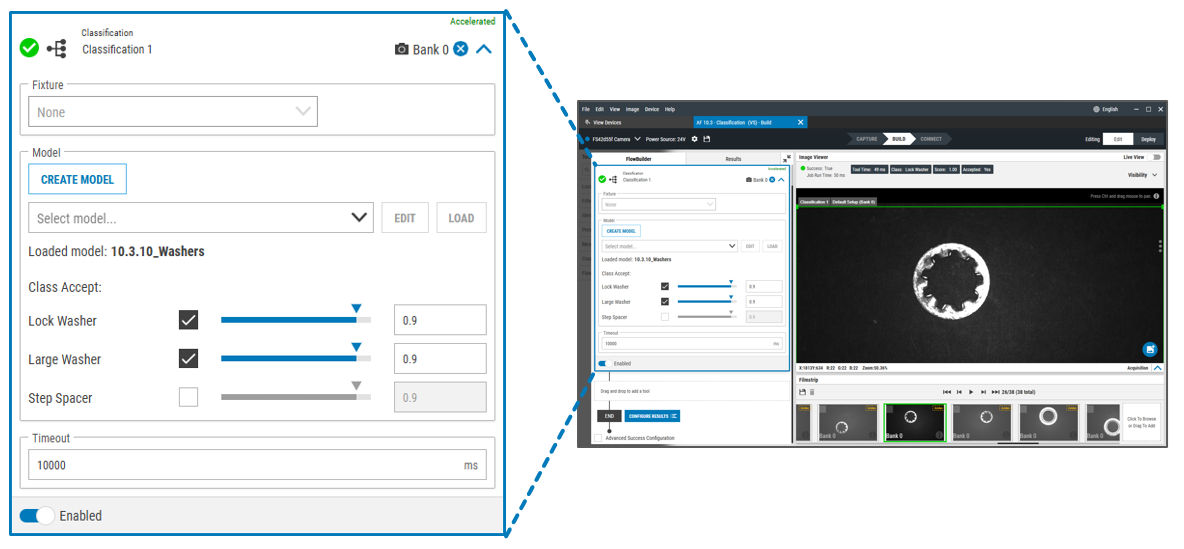
The NS42 executes these inspections locally by leveraging an integrated neural processing unit alongside built-in illumination and liquid autofocus. Rather than cycling through multiple exposure banks, the Classification tool processes single-image captures in tens of milliseconds directly on the device.
Operators train the model locally using the Aurora Focus Deep Learning Editor. After training on a modest set of labeled sample images, the user deploys the trained network directly onto the NS42 sensor. This embedded processing eliminates the need for a separate industrial PC or external vision controller at the inspection station.
Real-World Production Applications
Three diverse vertical applications demonstrate these deep learning capabilities in action:
- Logistics (Routing and Sortation Verification): Operators train the model using labeled images of empty and occupied trays. The system then makes pass/fail determinations to verify safe tray induction onto high-speed conveyors.
- Manufacturing (Assembly Verification): Automotive and electronics assembly lines require exact component placement. Workers train the sensor on correct and incorrect kit layouts, allowing the system to verify that the correct electrical connectors sit securely in their designated slots during final assembly.
- Packaging (Closure and Label Integrity Verification): High-volume bottling and canning facilities must secure caps and labels perfectly. The sensor evaluates packages using trained images to verify fully tightened caps, check for the presence of cardboard dividers inside shipping cases, and confirm correct label placement before palletization.
Seamless Line Integration
Real-time physical integration completes the automated inspection workflow. The programmable I/O on the NS42 supports industrial protocols like PROFINET, EtherNet/IP, and Modbus TCP. This connectivity enables inspection results to trigger rejects, route totes, or signal PLCs instantly, providing immediate feedback loop adjustments on the active production floor.
To learn more about implementing these quality control strategies, please contact our team via our official contact page at zebra.com/contact.


