0:00 / 0:00

Success Story
Incora slashes inventory search time by >95% with Zebra and Xemelgo RFID
Operating across 68 locations in 19 countries, Incora connects a global network of operators and suppliers, including defense, industrial manufacturing, and automotive.
Zebra Success Story: Incora
Overview: Warehouse and Distribution Challenge
Incora wanted to give warehouse teams the tools to track every part and movement in real time, reducing costly write-offs and ensuring the high service and safety standards aviation and defense demand.
Benefits / Outcomes
- >95% cut from lost stock search times
- >75% quicker handling of customer inventory inquiries (a few hours, not 2 days).
- Inventory exceptions resolved in <30 minutes, down from multi-hour manual resolution process
- Significant reduction in distribution center write-offs
- Expect fewer expedited delivery fees, improving supplier cost control
- Higher customer and stakeholder confidence in inventory accuracy

About Incora
At any given moment, a plane overhead is almost certainly carrying a piece handled or delivered by Incora. The US company keeps those aircraft in the air, supplying everything from fasteners and specialized hardware to chemical products—more than 570,000 SKUs in total. Operating across 68 locations in 19 countries, it connects a global network of operators and suppliers, including defense, industrial manufacturing, and automotive. "For a business working with components that ultimately go into aircraft, inventory accuracy is critical," notes Bradley Frank, Senior Distribution Center Manager at Incora. “It’s not just about cost. Safety and operational reliability are on the line here.”
The pressure intensifies with time-sensitive chemical products. "Maintaining clear oversight of chemical inventories is key to ensuring products are available and usable when customers need them," explains Brandon Journay, Sr. Manager, Global Business Improvement. “That continuity directly supports customer operations.” To further enhance this capability, Incora implemented Radio Frequency Identification (RFID), which offered something barcode scanning couldn't: automated, continuous tracking without requiring line-of-sight or manual scans at every step. By deploying Zebra hardware alongside Xemelgo’s cloud-based RFID software, Incora established real time monitoring for every item moving through its warehouse.
The Challenge
Within supply chain, inventory disruption is not uncommon, but in aviation and defense supply chains, even minor delays can have a huge impact, affecting aircraft availability or production lines. As volumes increase and parts move through multiple storage and handling areas, maintaining continuous visibility becomes essential.
Incora had been evaluating ways to further strengthen its inventory visibility. “By improving how materials are tracked and located, we’re reducing time spent searching, preventing unnecessary reorders, and ensuring seamless traceability throughout the supply chain,” explains Journay.
When a colleague in IT recommended Xemelgo and Xemelgo pointed to Zebra for hardware, the transformation and improvement teams decided to run an initial deployment, and the Jonestown plant was a natural choice. The site’s team had the leadership maturity and the openness to change required for a first-of-its-kind rollout. "Their willingness to try something new made this so much easier and more successful," reflects Journay.
At this point, Zebra wasn't a stranger. Incora already used their printers and handheld devices, so the leap felt manageable. "With Zebra, you know what you're getting, and that’s better quality," says Journay. "Coupled with the Xemelgo software, the solution as a whole is simple to use. All of this made it an easy decision."
Today, we can log in, identify the item, and have it ready for dispatch within around 30 minutes, without affecting customer operations.
The Solution
The team assembled on-site to build and test a solution spanning fixed and ceiling-mounted readers, handheld readers, and RFID printers. The changes slotted into existing workflows rather than upending them. "We've replaced standard labels with RFID-enabled ones. When read, they automatically feed data into the Xemelgo system, allowing full traceability, while our enterprise resource planning (ERP) software keeps inventory and status information up to date," explains Frank. Put-away, storage, picking, packing, shipping: the sequence stayed the same. But now, every step leaves a trace.
Across the warehouse, FX9600 Fixed RFID Readers in racking aisles track which section an item is sitting in, while ATR7000 Real-Time Locating System readers mounted on the ceiling sweep wide-open floor areas, creating a breadcrumb trail of where it has been. "If anything moves outside its expected path, we can pull up that carton in Xemelgo and see exactly where it was last located," Journay adds.
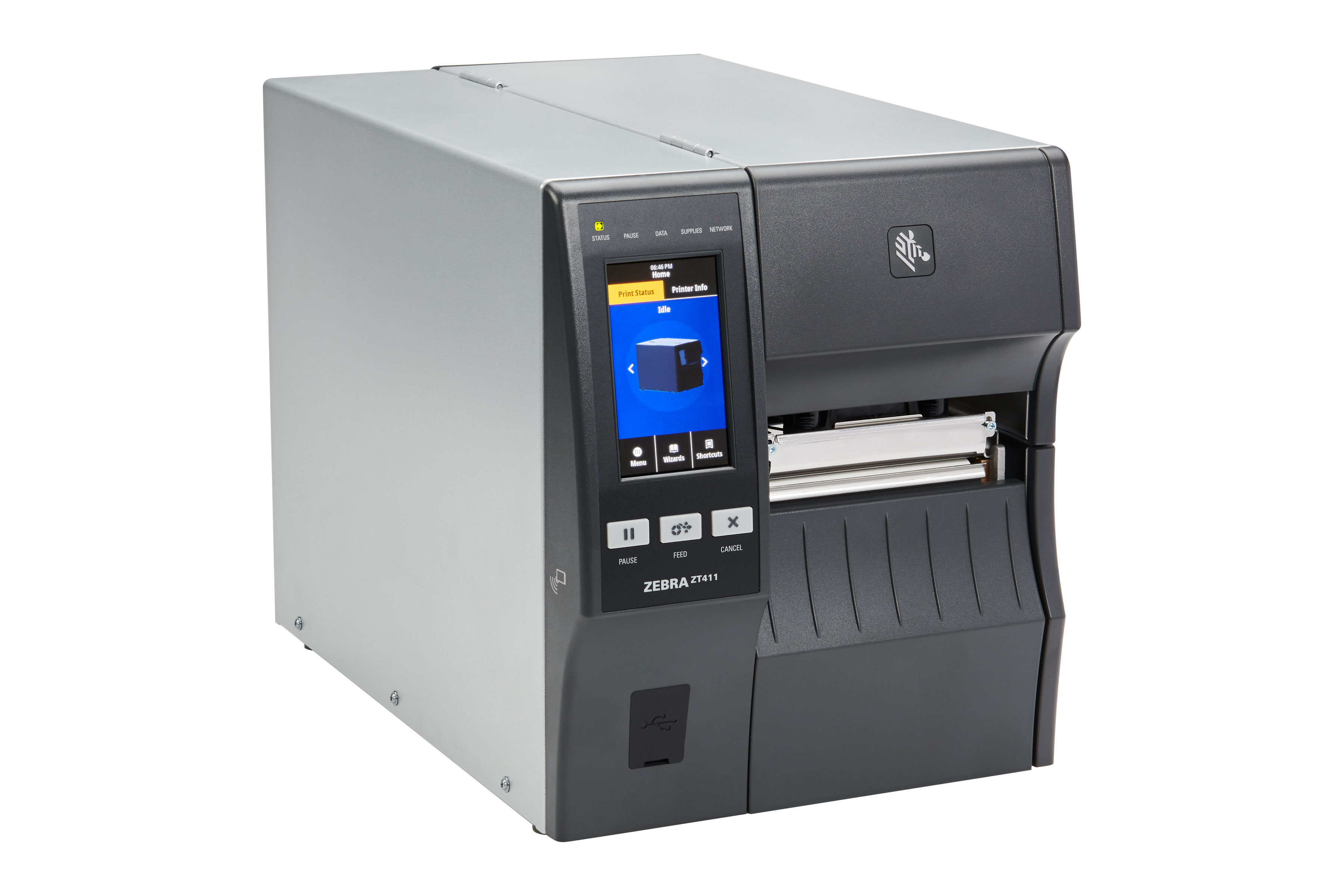
At the dock, teams label items the moment they enter the facility using RFID printers suited to each environment: ZT400 Series industrial printers for standard intake, ZQ600 Plus Series mobile printers, and ZD600 Series desktop printers for other points, including cold storage, where freezing temperatures and moisture demand rugged, durable equipment.
Data flows directly from the ERP: when a label prints, it generates an RF identifier and sends it, along with the receipt ID, to Xemelgo. As items move, readers automatically update their location—fixed readers for the general area, MC3300 RFID Series mobile computers for the exact position, primarily in the hands of the stock integrity team managing lost stock investigations, cycle counts, and material verification. "From our teams' perspective, workflows didn't change," says Journay. "They continue using the same labels, now enhanced with RFID, without adding extra steps."
The Zebra Difference: Outcome and Benefits
The rollout happened outside operational hours, with Xemelgo coordinating equipment ordering, hardware installation, and network cabling. Three months later, the initial deployment was live, and fast results followed. Picture an aircraft ready to take off that urgently needs a component. Warehouse teams can now access real time inventory data through Xemelgo and quickly confirm an item’s location using a mobile device. “Today, we can log in, identify the item, and have it ready for dispatch within around 30 minutes, without affecting customer operations,” says Journay.
The numbers back it up. "Time spent verifying the location of inventory has been reduced by more than 95%," reports Frank. Response times to customer inventory inquiries have dropped from two days to a few hours. Processes have been further enhanced across all storage environments, including cold storage, where advanced digital reads now enable fast, accurate inventory management. This approach is expected to reduce write-offs and continue to unlock wider cost efficiencies, including fewer expedited supplier orders.
Beyond the metrics, the shift in confidence is just as tangible. "Our capability to manage our inventory was immediately enhanced," observes Frank. "With better visibility and tracking, stakeholders have greater assurance that items are accurately tracked, readily available, and appropriately stocked."
The Jonestown initial deployment set the blueprint for everything that followed. Lessons absorbed on-site are already compressing timelines for future rollouts, and the transformation team is eyeing new applications: automatically receiving intercompany transfers, processing supplier shipments via RFID, and extending traceability to customers tracking their own materials. "We have customers who are getting interested in RFID labelling, making it traceable from our dock to theirs,” adds Journay.
None of that expansion happens without a foundation that keeps operations on the warehouse floor running—mapping movements, aligning processes, and pushing rollouts. For customers, the experience is seamless: inventory where it should be, responses in hours, shipments out the door without escalating issues. For someone with extensive experience overseeing warehouse operations, Journay notes that inventory visibility is a common focus area across the industry. “Inventory challenges are not unique to any one organization,” he says. “In our case, the RFID solution delivered improvements that exceeded initial expectations."
Featured Products and Solutions